Rooftop Unit Rigging and Crane Liability for HVAC Contractors: Riggers Liability, Dropped Units, Crane Hire, and Certificates
See How We're Different
or call us: 888-862-1202
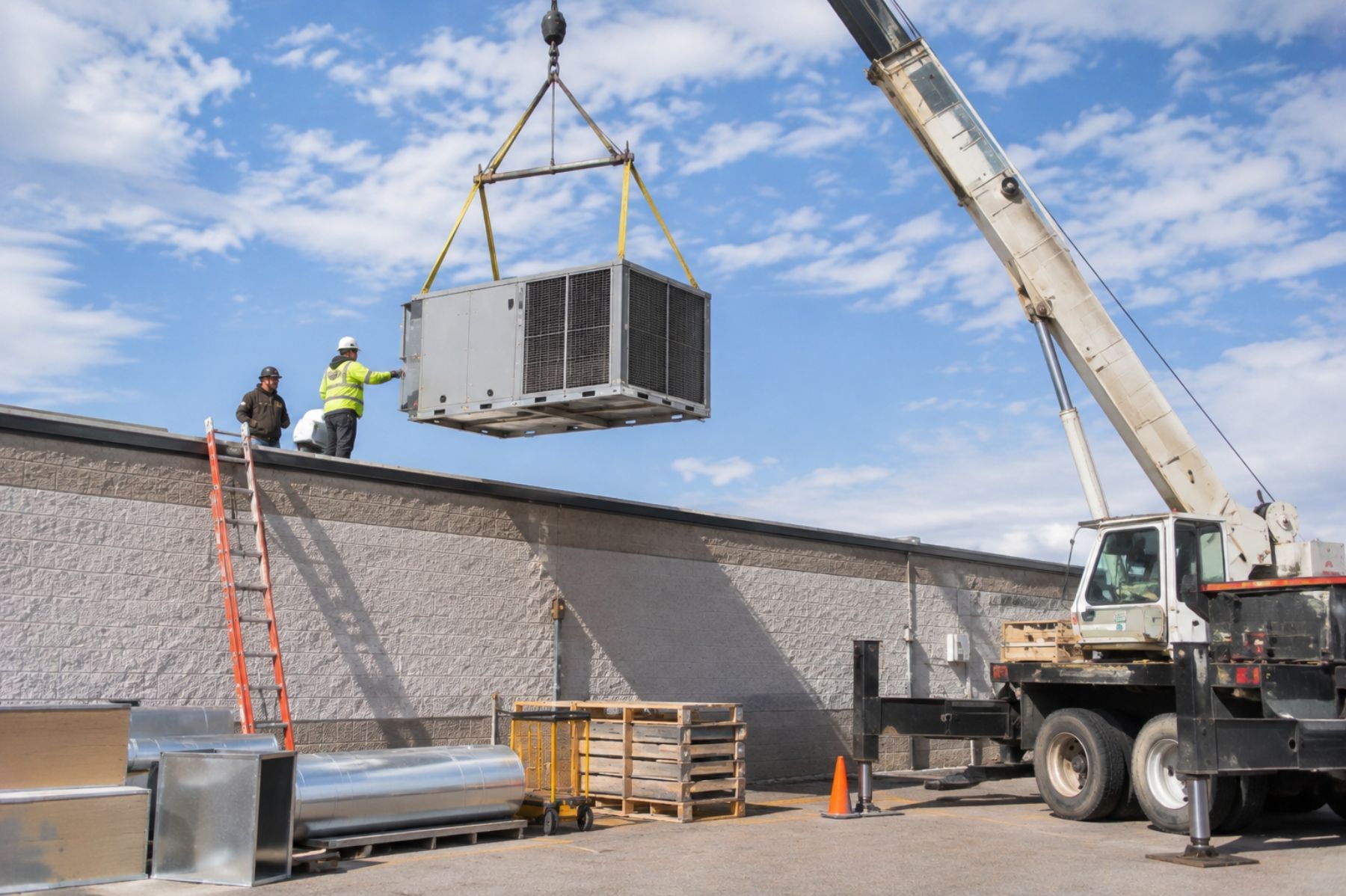
When a crane lifts a rooftop unit over a building, a large share of your company's financial exposure is suspended from that hook. One snapped sling or misjudged load chart can turn a routine changeout into a destroyed unit, a crushed parking deck, and a lawsuit naming your business as the party responsible for the lift.
Most HVAC owners assume their general liability policy covers this moment. Many find out otherwise only after a claim is denied. Rooftop unit rigging and crane liability depend on a specific set of policies, contract terms, and certificates that do not interact the way contractors often expect.
This guide covers the gaps that cause the most expensive surprises:
- Riggers liability
- Dropped-unit exposure
- Crane hire versus contract lift arrangements
- Certificate verification
Goal: You should finish this article able to review your own program, ask your broker sharper questions, and structure crane jobs so a dropped unit does not become a business-ending event.
The High Stakes of Rooftop Unit Installation
A packaged rooftop unit is heavy and expensive. It is also often custom-configured, with long manufacturer lead times. If it falls, you lose more than the equipment. You also absorb reorder delays, idle crew time, rescheduled crane mobilization, and the possibility that your customer's building sits without cooling during peak season.
The damage rarely stops with the unit. Consider a common claim scenario. A 15-ton RTU swings during the pick, strikes a parapet, and lands partly on the roof deck. The fall cracks structural members, punctures the membrane, and breaks a sprinkler line. Water then reaches tenant spaces below, damaging inventory and IT equipment. In a single afternoon, you can face these losses:
- Equipment loss: The RTU itself, plus curb adapters and accessories
- Building damage: Roof deck, membrane, parapet, and interior finishes
- Third-party property: Tenant inventory, vehicles in the lot, and neighboring structures
- Bodily injury: Ground crew, pedestrians, and other trades
- Business interruption claims: Lost revenue from affected tenants
Each category may fall under a different policy, or under none at all. A single event can produce losses large enough to wipe out several years of profit for a mid-sized mechanical contractor.
Responsibility does not automatically shift to others on site, either. Under general principles of contractor liability,
independent contractors like HVAC firms remain responsible for the open and obvious hazards of their trade, such as unguarded roof edges, and cannot push that exposure onto the general contractor. In practice, the GC's insurance will not absorb a failure in your rigging operation.
Understanding Riggers Liability vs. General Liability
Riggers liability is a specialized inland marine coverage. It protects property belonging to others while that property is being hoisted, lowered, or moved under your control. General liability is designed for third-party bodily injury and property damage. It deliberately excludes property you are actively working on.
That distinction sounds technical, but it decides whether a dropped RTU claim gets paid. You need to know where each policy begins and ends before you schedule your next pick.
The Care, Custody, and Control Exclusion
Nearly every commercial general liability form contains a care, custody, and control (CCC) exclusion. It removes coverage for damage to property in your possession or under your control while you work on it. During a lift, the unit is clearly in your care. Your crew rigged it, your foreman signaled it, and your lift plan governed it.
Contractors often assume that because the customer owns the RTU, damage to it counts as third-party property damage. Carriers do not read it that way. Ownership matters less than control. Once your slings are attached, the unit is effectively yours for insurance purposes until it is set on the curb and released.
Related exclusions add to the problem. The "your work" and "that particular part" exclusions can deny coverage for damage to the specific portion of the property you were working on. If the dropped unit also damages the curb you just installed, that portion may be excluded as well.
Why Your GL Policy Won't Cover a Dropped Unit
Picture the claim file. The customer's owner-supplied RTU falls during your lift. The customer demands replacement cost, and you tender the claim to your GL carrier. The adjuster cites the CCC exclusion and denies coverage for the unit. The carrier may still accept the roof damage and the tenant losses as third-party property damage.
You now owe the full replacement cost of the equipment yourself. Riggers liability fills exactly this gap. It is typically written on either a legal liability basis, which pays only when you are found negligent, or a direct damage basis, which pays regardless of fault. Direct damage forms cost more, but they avoid lengthy disputes with customers over who caused the drop.
Important: Check whether your riggers policy covers property that you own, such as contractor-furnished units bought for resale, as well as owner-furnished equipment. Some forms cover only property of others.
Crane Hire and Third-Party Risks
How you contract for the crane can matter as much as which policies you carry. There are two main structures, and they assign liability very differently.
In a bare crane hire, the crane company supplies the machine and an operator. The rest of the job belongs to you. Industry guidance on lift arrangements states plainly that in a Crane Hire, the Hirer is responsible for the lift plan, supervision, and rigging. For an HVAC contractor, that means you own the engineering judgment behind the lift, even though someone else is running the controls.
A contract lift works the opposite way. The crane company supplies a turnkey service, including the lift plan, rigging, and supervision. It also assumes full legal liability for executing the lift. This shifts much of the risk off your books. The trade-off is a higher price and less scheduling flexibility.
This matters because many HVAC firms book a "crane hire" by phone without realizing they have just accepted responsibility for the entire lift. Read the rental agreement carefully. Phrases such as "operated and maintained" or "hirer to provide competent supervision" signal a bare hire.
Vicarious Liability for Subcontracted Operators
Under many crane hire agreements, the operator is legally treated as your borrowed servant for the duration of the job. If the operator misjudges a radius and the boom contacts a power line, you may be held vicariously liable for the operator's negligence. This is true even though you never employed, trained, or certified that person.
Courts look at who directed the work. If your foreman signaled the lift and chose the pick points, the argument that the operator worked for you becomes much stronger. Your GL policy may respond to resulting bodily injury, but only if no exclusion for crane or aircraft operations applies. Ask your broker directly whether such an exclusion exists on your form.
Non-Owned Crane Coverage Essentials
Hired crane agreements often make you responsible for damage to the crane itself. A tip-over, outrigger collapse, or boom failure can produce a claim large enough to rival the value of the RTU.
Coverage for that exposure usually comes from a contractor's equipment floater with a rented or leased equipment extension. Confirm these items:
- Limits: Large enough to cover the crane class you actually hire, not a skid steer
- Rental reimbursement: Pays the crane owner's lost rental income during repairs
- Operator exclusion: Some forms exclude cranes rented with an operator
- Hold harmless language:
Matches the indemnity terms in the rental contract
Comparing Coverage: RTU Transport and Lifting
A rooftop unit passes through several exposure phases. It sits at the supplier, rides on a truck, waits on the jobsite, goes up on the hook, and is finally set and connected. Each phase may trigger a different policy. Gaps tend to appear at the handoffs, especially at the moment the unit leaves the truck bed.
| Exposure Phase | Primary Coverage | Common Gap |
|---|---|---|
| Transit to site | Motor truck cargo or installation floater | Owner-furnished units excluded |
| Staged on jobsite | Installation floater / builder's risk | Theft or vandalism sublimits |
| During the lift | Riggers liability | Not purchased; GL CCC exclusion applies |
| Crane damage | Rented equipment floater | Crane rented with operator excluded |
| Third-party injury | General liability | Crane operations exclusion |
| Third-party property | General liability | Damage to "your work" excluded |
| After completion | GL completed operations | Policy lapse or low aggregate |
Completed operations coverage deserves attention here. A unit set slightly off its curb can stress the gasketing and lead to water intrusion months later. A brazed joint stressed during rigging can develop a slow refrigerant leak after turnover. Condensate drainage problems that start with a pitched setting may not show up until ceiling tiles stain. These claims fall under the products-completed operations hazard, not riggers coverage. Keep that aggregate healthy and avoid letting the policy lapse.
Good vs. Bad: A good program names riggers liability with a per-occurrence limit sized to your largest typical unit plus a margin for multiple units on one pick. A bad program relies on an installation floater with a generic transit clause and assumes it covers hoisting. Many floaters expressly exclude property while it is being lifted.
Managing Certificates of Insurance (COIs)
Certificates are how risk moves between parties on paper. You collect them from crane companies, and GCs and property owners collect them from you. A certificate is not a policy and grants no coverage on its own. Even so, sloppy certificate practices create real exposure on both sides.
Verifying Limits and Additional Insured Status
The ACORD 25 revision released in late 2025 changed how limits can appear. The updated form includes a disclaimer stating that limits shown are inclusive of amounts requested by the certificate holder and may not reflect policy limits in excess of those requested. Here's what that means for you: a crane company's certificate showing exactly the limits your contract requires does not tell you the true size of its program. Its full policy may carry more, or the certificate may simply mirror your request.
When you review a crane vendor's certificate, check these items:
- Named insured: Matches the legal entity on the rental contract
- Policy dates: Cover the full lift date, including weather delays
- Additional insured: You are listed, and the endorsement form number is referenced
- Primary and noncontributory: Wording appears if your contract requires it
- Riggers or crane coverage: Shown separately when the vendor performs a contract lift
Request the actual additional insured endorsement, not just a checkbox on the certificate. Blanket endorsements tied to "written contract" requirements only work if your signed agreement exists before the loss.
Waivers of Subrogation in Rigging Contracts
A waiver of subrogation prevents an insurer from recovering its claim payment from another party after paying a loss. Crane rental agreements often require you to waive subrogation in favor of the crane company. If you agree and your riggers carrier pays for a dropped unit, that carrier cannot pursue the operator, even if the operator caused the drop.
Signing that waiver without a matching endorsement on your policy can breach your policy conditions. Your carrier may argue that you impaired its recovery rights. Before you sign any rigging contract, send the indemnity and waiver sections to your broker. A quick review can confirm whether your forms permit the waiver or whether an endorsement needs to be added first.
Risk Mitigation Strategies for the Job Site
Underwriters price riggers coverage partly on your loss history and documented lift procedures. Strong field controls reduce claims and support better terms at renewal. They also produce evidence that protects you when a loss does happen.
Start with the lift plan. For any critical pick, document these details:
- Unit weight and center of gravity: Taken from the manufacturer's submittal, not estimated
- Crane configuration: Radius, boom length, counterweight, and percentage of chart capacity
- Rigging hardware: Sling type, angle, rated capacity, and inspection status
- Ground conditions: Outrigger pad placement and any underground utilities
- Exclusion zones: Barricades, flaggers, and pedestrian rerouting
- Weather limits: Wind speed thresholds for stopping the lift
Regional conditions matter as well. Gulf Coast and Plains contractors face sudden gusts during spring storm season. Northern contractors deal with frozen ground that changes outrigger bearing. Build local weather triggers into your plan rather than relying on generic guidance.
Qualifications are equally important. Use certified riggers and signal persons, and keep copies of their credentials on file. Inspect slings, shackles, and spreader bars before every lift, and tag any damaged hardware out of service immediately. Brief the crew at the start of each pick so everyone knows the plan and the stop-work signal.
Documentation decides claims. Photograph the unit at delivery, after rigging, and after setting. Record crane inspection logs and the operator's certification details. If a drop occurs, secure the slings and hardware as evidence, photograph the scene before cleanup, and get a written damage assessment from a technician. That assessment should note compressor housing damage, cracked coils, bent cabinet panels, and any damage to control boards. Clear evidence helps you defend a fault dispute or support a direct damage claim.
Common Questions About Crane and Rigging Insurance
Does my general liability insurance cover a rooftop unit if it falls during a lift? Usually not. The care, custody, and control exclusion removes coverage for property you are handling, so you need riggers liability for the unit itself.
What's the difference between a crane hire and a contract lift? In a crane hire, you rent the crane and operator but remain responsible for planning, rigging, and supervision. In a contract lift, the crane company handles all of it and takes on the liability.
Do I need riggers coverage if I only do a few crane jobs a year? Yes. One dropped unit can cost more than years of premiums, and some carriers offer per-job or annual policies for occasional lifts.
Why does the crane company's certificate show the exact limits I asked for? The current ACORD 25 lets brokers display only the limits you request. Ask for the full policy declarations if you need to know the vendor's total capacity.
Who pays if the rented crane tips over on my job? Under many crane hire agreements, you do. A rented equipment floater that includes cranes rented with an operator is the usual way to cover that exposure.
Should I sign a waiver of subrogation for the crane company? Only after confirming that your policies allow it. Signing without the right endorsement can jeopardize your own coverage.
Protecting Your Business During Every Lift
Crane picks are short, but their financial consequences can last for years. Your general liability policy handles third-party injury and some property damage. It will not replace the unit hanging from the hook. Riggers liability closes that gap. A rented equipment floater protects you against crane damage, and completed operations coverage handles problems that show up months after the job is finished.
Contracts shape all of it. A bare crane hire puts the lift plan and rigging on you, while a contract lift shifts that burden to the crane company. Certificates must be verified against the actual endorsements, and waivers of subrogation need your broker's approval before you sign.
Your next steps:
- Pull your GL, inland marine, and equipment policies.
- Identify whether riggers coverage exists and at what limit.
- Have your broker review your next crane rental agreement before you book.
A well-built rigging program also signals discipline to GCs, sureties, and future buyers of your business.