Legionella and Cooling Tower Liability for HVAC Contractors: Water Management Plans, ASHRAE 188, Exclusions, and Coverage Options
See How We're Different
or call us: 888-862-1202
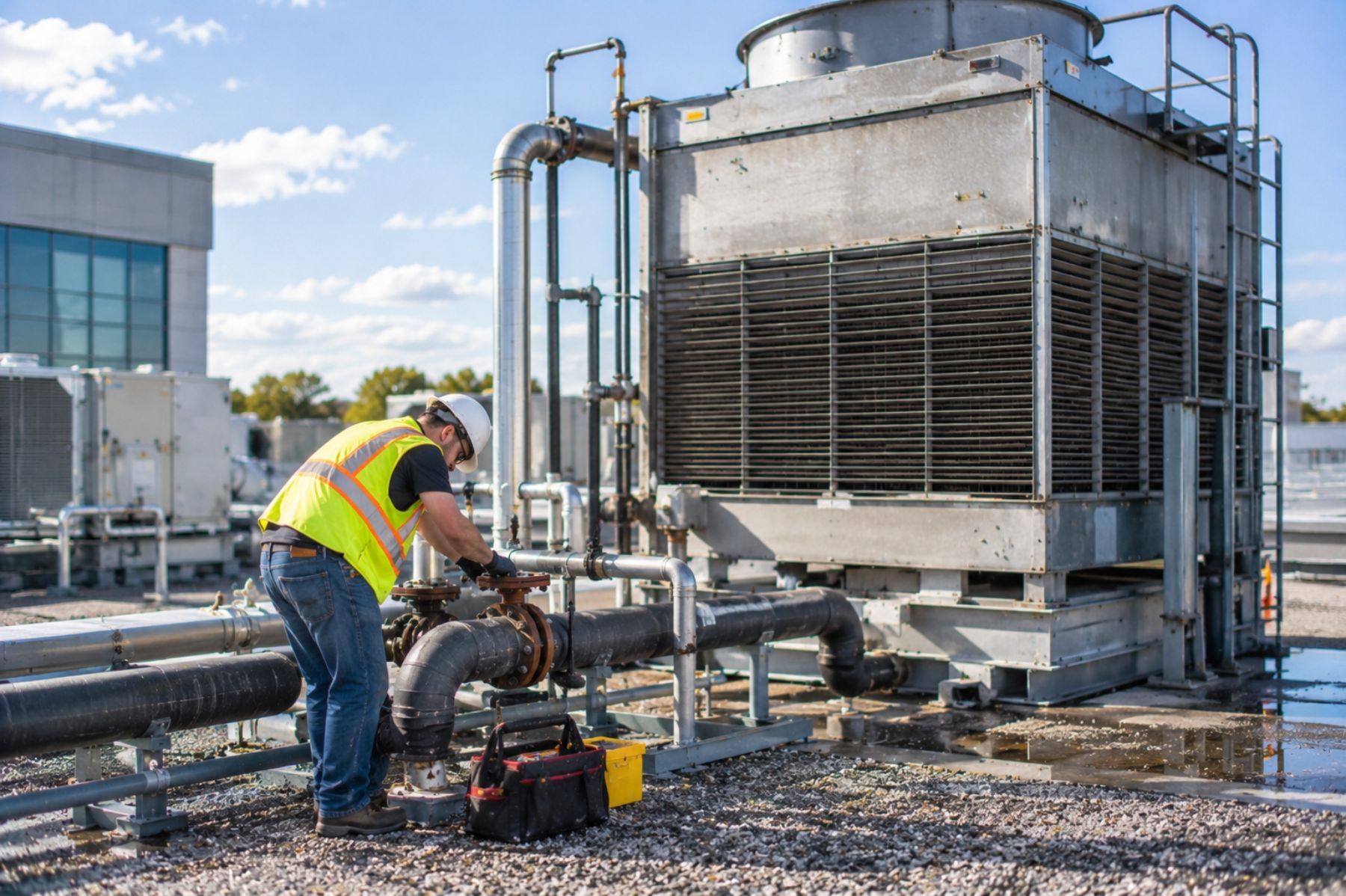
A cooling tower on a hospital roof can pass every mechanical inspection and still spread Legionella across several city blocks. When that happens, plaintiffs' attorneys look past the building owner and toward everyone who touched the system, including the HVAC contractor who serviced the fans, adjusted the drift eliminators, or signed off on the last water treatment visit.
For HVAC firms, Legionella exposure is no longer a niche concern reserved for water treatment specialists. Outbreaks are rising, local regulations are tightening, and many contractors carry insurance programs that were never built to respond to a bacteria claim.
This guide covers cooling tower liability for HVAC contractors from four angles: your role under ASHRAE 188 water management plans, the exclusions buried in standard policies, the coverage options that actually respond, and the contract language that shifts risk before a claim ever arrives.
Objective: by the end, you should be able to review your current policies,
identify where a Legionella claim would fall through, and know what to ask your broker.
Understanding Legionella Risks in Cooling Tower Maintenance
Legionella bacteria thrive in warm, stagnant water between roughly the temperatures found in a summer cooling tower basin. Towers aerosolize that water through drift, and a single contaminated unit can expose people far from the building itself. That is why cooling tower outbreaks tend to produce mass-tort litigation rather than a single injury claim.
The numbers are moving in the wrong direction. Reported U.S. incidence of Legionnaires' disease rose to a provisional 2.9 cases per 100,000 people in 2025, and a July 2025 outbreak in Harlem sickened 118 people and killed seven. An event of that size generates wrongful death suits, medical expense claims, and regulatory investigations at the same time.
For contractors, the risk usually traces back to specific service failures:
- Dead legs left behind after piping modifications or equipment removal
- Damaged drift eliminators that release excess aerosol
- Biofilm buildup in fill media that was never cleaned during a scheduled service
- Startup errors where a tower sat idle for months, then restarted without disinfection
- Failed chemical feed pumps or controllers that went unreported to the owner
Here's what that means for you: even if you never handle a drop of biocide, a mechanical decision you made can change water flow, temperature, or stagnation in ways that support bacterial growth. A plaintiff's expert will reconstruct your service history line by line.
The exposure also outlasts the job. A tower you retrofitted in spring may not cause illness until a heat wave in August, long after your crew has left the site. That delayed manifestation is exactly why completed operations coverage matters so much in this class of claim, a point we return to below.
The HVAC Contractor's Role in ASHRAE 188 Compliance
ASHRAE Standard 188 establishes minimum risk management requirements for building water systems, including cooling towers. The building owner holds primary responsibility for the program. The catch is that owners rarely have in-house expertise, so they lean on HVAC contractors, water treatment vendors, and consultants to carry out the plan.
The 2021 revision raised the stakes. ASHRAE 188-2021 replaced permissive language with enforceable language to make it easier for jurisdictions to adopt water management plans directly into building codes. Once a standard becomes code, it also becomes the yardstick a jury uses to measure whether your work met the standard of care.
Local rules are tightening on top of that. In New York City, Local Law 159 of 2025 requires building owners to test cooling towers for Legionella every 31 days while in operation, effective May 8, 2026. New York State has also moved to require that maintenance deficiencies be addressed within 48 hours, with serious microbial threats remediated within 24 hours.
If you service towers in New York, those response windows effectively become your contractual deadlines. Miss one, and you may own part of the outcome.
Core Components of a Water Management Plan (WMP)
A compliant water management plan generally includes:
- Program team with named roles, including outside contractors
- System description and process flow diagrams
- Hazard analysis identifying where growth and aerosolization can occur
- Control locations and control limits for parameters like temperature, disinfectant residual, and pH
- Corrective actions when readings fall outside limits
- Verification and validation through testing and review
- Documentation and communication procedures
Your work most often touches control locations and corrective actions. If the plan names your firm, you are part of the program team whether you signed anything or not.
Documentation and Record-Keeping as a Defense Strategy
In a Legionella suit, your records are your defense. A technician's note that reads "tower serviced, all OK" is close to useless when an expert asks what was inspected, measured, and reported.
Strong documentation includes timestamped photographs of fill, basin, and drift eliminators, written findings on any observed biofilm or scale, and a signed record showing you notified the owner of deficiencies outside your scope. That last item matters most. Many contractors lose cases not because they caused contamination, but because they saw a problem and cannot prove they reported it. Keep service reports for at least the length of your state's statute of repose, and store them where a departing employee cannot take them.
Where Standard General Liability Policies Fall Short
Most HVAC contractors assume their Commercial General Liability policy will respond to any bodily injury claim arising from their work. For Legionella, that assumption is often wrong, and contractors usually discover it only after a carrier issues a reservation of rights letter.
The Impact of Pollution and Bacteria Exclusions
Standard CGL policies typically contain a Total Pollution Exclusion or a specific Fungi/Bacteria Exclusion that generally removes coverage for bodily injury claims arising from Legionella. Carriers argue that bacteria are an "irritant or contaminant," or they rely on endorsement wording that expressly names bacteria, fungi, or microbial matter.
Read your policy endorsements, not just the declarations page. Common wording variations include:
- Total Pollution Exclusion: broad wording that carriers apply to discharge of contaminants
- Fungi or Bacteria Exclusion: expressly excludes injury from bacterial exposure
- Limited Fungi or Bacteria Coverage: sublimits that may be a small fraction of your occurrence limit
- Exceptions for bacteria in consumed goods: irrelevant to cooling towers
One thing to keep in mind: courts do not always read these exclusions the same way, and outcomes depend on exact wording and state law. That uncertainty cuts both ways. You may end up in coverage litigation with your own carrier while defending a wrongful death suit, which is the worst possible position for a small firm.
A common client mistake is buying a cheaper CGL renewal without noticing the carrier added a bacteria endorsement. The premium dropped because the coverage did too.
Professional Liability vs. General Liability for HVAC
General liability responds to bodily injury and property damage caused by your operations. Professional liability, or E&O, responds to financial loss caused by your advice, design, or professional judgment.
Legionella claims frequently blend both. If your technician misreplaced a drift eliminator, that looks like a GL claim. If your project manager recommended shutting down a chemical feed system during a retrofit, or designed a piping change that created a dead leg, the plaintiff will frame it as a professional error. Many CGL policies carry a professional services exclusion, so design and consulting work may fall outside them entirely. HVAC firms that offer design-build services, commissioning, or water system recommendations need both policies, coordinated so neither one leaves a gap.
Comparison: Standard GL vs. Specialized Legionella Coverage
The table below summarizes how a typical program responds to common Legionella claim scenarios. Actual results depend on your policy forms, endorsements, and state law.
| Claim Scenario | Standard CGL | CPL Policy | E&O Policy |
|---|---|---|---|
| Bodily injury from tower aerosol | Often excluded | Typically covered | Only if tied to advice |
| Wrongful death lawsuit | Often excluded | Typically covered | Only if tied to advice |
| Remediation and disinfection costs | Rarely covered | Often covered | Limited |
| Faulty WMP recommendations | Excluded (professional services) | Varies | Covered |
| Claim after job completion | Covered only if not excluded | Check completed ops wording | Claims-made trigger |
| Defense costs | Reservation of rights likely | Typically included | Typically included |
| Regulatory fines | Generally not covered | Rarely covered | Rarely covered |
This matters because the gap between columns one and two is where most HVAC contractors sit today. A firm with only a CGL policy is often effectively self-insured for the most severe category of cooling tower claim.
Pay close attention to the completed operations row. Legionella outbreaks often surface weeks or months after a contractor finishes work, much like a refrigerant leak at a poorly brazed joint or a condensate drain that slowly backs up. If your pollution coverage excludes completed operations, or your policy has lapsed by the time the claim arrives, you lose protection precisely when you need it.
Good vs. Bad example:
- Bad: A contractor relies on a $1 million CGL policy with a bacteria exclusion, assuming the umbrella will catch the overflow. The umbrella follows form and carries the same exclusion.
- Good: A contractor carries CPL with completed operations coverage, a professional liability policy with a retroactive date covering prior work, and an umbrella that sits above both.
Navigating Environmental and Pollution Insurance Options
Specialty environmental coverage fills the gap that standard trade policies leave open. These policies are underwritten differently, so expect a detailed application asking about your cooling tower work, water treatment involvement, and documentation practices.
Contractors Pollution Liability (CPL) Policies
A CPL policy covers bodily injury, property damage, and cleanup costs arising from pollution conditions caused by your operations. Many carriers now write CPL with explicit coverage for mold, Legionella, and other bacteria, though you should confirm that wording instead of assuming it.
Contractors Professional and Pollution Liability (CPPL) packages go further. They provide coverage for site assessments and remediation planning, which are often excluded from standard trade policies. For an HVAC firm that both performs mechanical work and helps owners develop corrective actions, a combined package reduces the risk of two carriers pointing at each other.
When reviewing CPL quotes, check:
- Occurrence vs. claims-made trigger, with occurrence preferred for latent bacterial claims
- Explicit Legionella or microbial matter coverage in the insuring agreement
- Completed operations period, ideally extending several years past project completion
- Defense inside or outside limits, since mass-tort defense can consume a policy fast
- Sublimits on bacteria that quietly cap your protection
Errors and Omissions (E&O) for Water Treatment Advice
If your staff offer any opinion on water chemistry, biocide programs, startup procedures, or WMP content, you are giving professional advice. An E&O policy protects you when that advice is alleged to be wrong, incomplete, or negligently delivered.
Consider a technician who tells a property manager that a tower idle since October can restart without hyperhalogenation. If occupants fall ill, the claim targets that advice, not the wrench work. E&O policies are usually claims-made, so maintain continuous coverage and protect your retroactive date when switching carriers. Losing that date can strip coverage from years of prior tower work in a single renewal.
Contractual Risk Transfer and Indemnity Clauses
Insurance is your second line of defense. Your contract is the first. Many HVAC firms sign owner-drafted service agreements that quietly make them responsible for the entire water management program.
Watch for these contract provisions:
- Broad-form indemnity requiring you to cover the owner's own negligence, which some states limit or void
- Scope language that names you "responsible for Legionella control" without defining tasks
- Additional insured requirements that your CGL cannot satisfy because of a bacteria exclusion
- Waivers of subrogation that block your carrier from pursuing the water treatment vendor
- Response time commitments that exceed what your crew can deliver
Define scope precisely. If you service mechanical components and a separate vendor handles chemistry, the contract should say so in plain terms. Include language that requires the owner to maintain a current WMP and to retain a qualified water treatment provider.
The October 2026 litigation tied to the Harlem outbreak shows how this plays out. Plaintiffs filed suits against the City of New York and maintenance contractors, alleging failure to follow the State Sanitary Code. When multiple parties share a tower, every defendant's contract becomes evidence.
Also require your subcontractors to carry CPL and name you as additional insured. If your sub causes the contamination and carries only a CGL policy with a bacteria exclusion, the claim slides back to you. A certificate of insurance alone does not prove coverage, so request the actual endorsements.
Common Questions About Legionella Liability
Does my general liability policy cover Legionella claims? Usually not. Most standard CGL policies include a pollution or bacteria exclusion that removes coverage for injuries caused by Legionella.
Can I be sued if the building owner is responsible for the water management plan? Yes. Plaintiffs typically name every party that serviced the cooling tower, and your service records will determine how much liability you share.
What's the difference between pollution liability and E&O for HVAC work? Pollution liability covers injuries and cleanup caused by your physical work. E&O covers losses caused by your advice, design, or recommendations.
Do I need Legionella coverage if I only service tower fans and motors? Probably. Mechanical work like replacing fill, adjusting eliminators, or modifying piping can affect bacterial growth, and claims often appear after the job is finished.
How long after a job can a Legionella claim show up? Weeks, months, or longer. That's why completed operations coverage and continuous claims-made policies matter for cooling tower work.
Will contract language protect me without insurance? Only partly. Indemnity clauses shift risk on paper, but you still need insurance with the financial capacity to back those promises.
Protecting Your Business Against Waterborne Pathogens
Legionella exposure sits at the intersection of rising disease rates, tougher regulations, and insurance forms that were never written with cooling towers in mind. ASHRAE 188's enforceable language and New York's new testing and response deadlines raise the standard of care your work will be measured against.
The insurance gap is real, but fixable. Pair a CPL or CPPL policy with E&O coverage, confirm completed operations wording, and verify that your umbrella does not carry the same bacteria exclusion as your CGL. Then tighten your contracts and documentation so a jury sees a contractor who defined scope, reported deficiencies, and kept proof.
Your next steps:
- Pull your CGL endorsements and search for pollution and bacteria wording
- Audit service reports from your last five cooling tower jobs
- Request CPL and E&O quotes that name Legionella explicitly
- Revise service agreements to define scope and response obligations
A well-structured program does more than satisfy a certificate request. It makes your firm the contractor building owners trust with their highest-risk systems.